
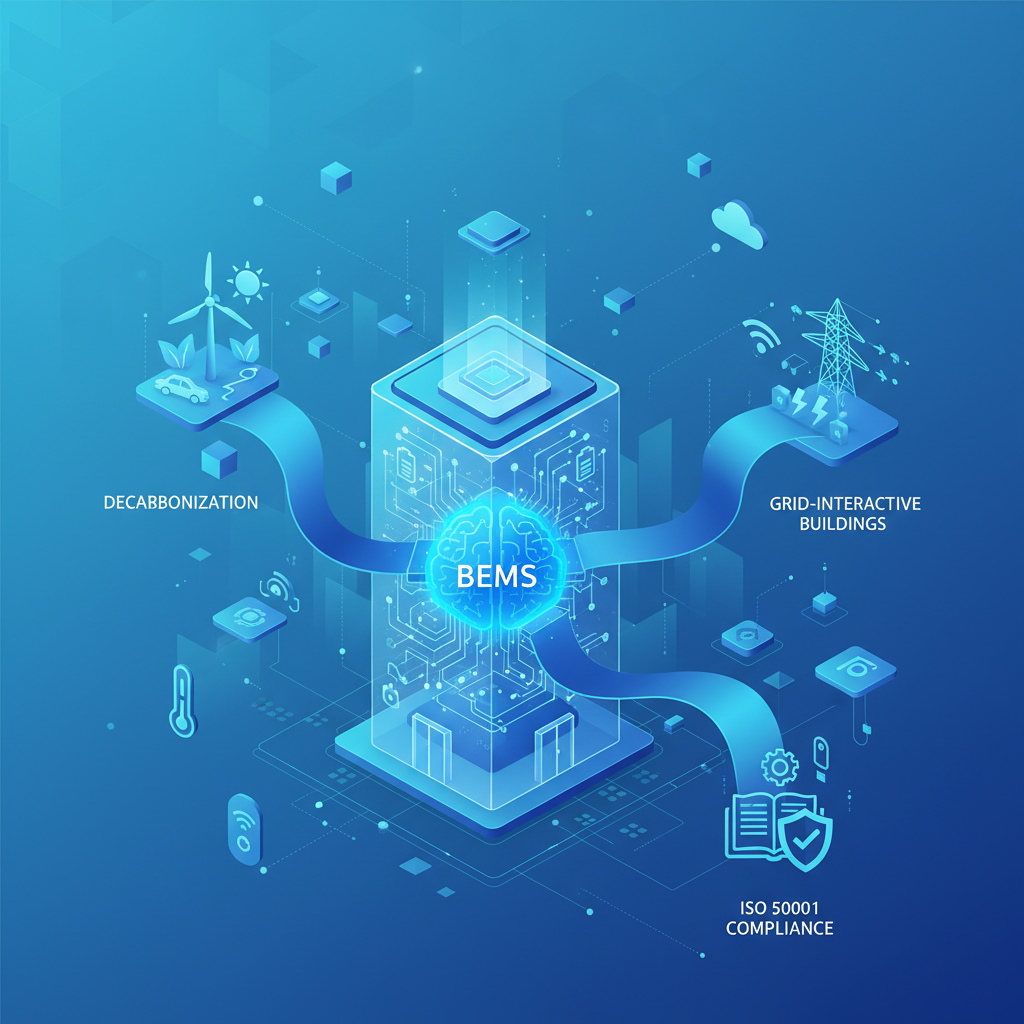
BEMS as Operational Infrastructure: Unlocking Decarbonization, Grid-Interactive Buildings, and ISO 50001 Compliance
The latest QYResearch report, “Industrial and Commercial Building Energy Management System – Global Market Share and Ranking, Overall Sales and Demand Forecast 2026–2032,” confirms what many facility leaders already feel on the ground: Building Energy Management Systems (BEMS) are no longer niche efficiency tools. They are becoming core operational infrastructure for factories, hospitals, offices, data centers, and campuses that must decarbonize while staying reliable and profitable.
With the global BEMS market projected to grow from USD 6.97 billion in 2025 to USD 16.08 billion by 2032 (12.2% CAGR), the stakes are high. The winners will be organizations that treat energy not as a utility bill to be checked once a month, but as a continuously optimized variable managed through robust building automation, BACnet-based interoperability, and ISO 50001-aligned processes.
From One-Time Retrofits to BEMS as Continuous Operational Infrastructure
Most large buildings and industrial sites have already implemented classic energy projects—lighting retrofits, VFDs, boiler upgrades. Yet QYResearch notes what every energy manager knows: performance drifts. Sensors go out of calibration, sequences are modified in a hurry, and new equipment gets bolted on without holistic recommissioning. The result is a slow, costly slide back to inefficiency.
An industrial and commercial BEMS closes this gap by creating a continuous loop of measurement, analysis, and action. It aggregates data from utility meters, submeters, sensors, and control points; transforms that into dashboards, alarms, and trends; and orchestrates targeted interventions that reduce waste without sacrificing comfort, safety, or throughput. In practice, this shifts building automation from static control logic to an actively managed operational infrastructure, comparable to how production quality or safety systems are continuously managed.
This operational mindset aligns tightly with ISO 50001, which encodes the Plan–Do–Check–Act (PDCA) cycle into energy management. Organizations that adopt BEMS as infrastructure—not a side project—can institutionalize baselining, KPIs, root-cause analysis, and management review, turning scattered retrofits into a documented, repeatable program that typically delivers 10–20% energy intensity improvement over five years.
Market Momentum: A USD 16 Billion BEMS Landscape Shaped by Policy and Portfolios
QYResearch projects the global industrial and commercial BEMS market to reach USD 16.08 billion by 2032, up from USD 6.97 billion in 2025. This growth is not evenly distributed. North America leads with roughly 35% share, powered by demand response programs, state decarbonization mandates like California Title 24 and New York’s CLCPA, and mature benchmarking regimes. Europe follows with about 30%, driven by the EU Energy Efficiency Directive (EED) recast, mandatory energy audits, and carbon pricing.
Asia-Pacific already accounts for around 28% and is the fastest-growing region, boosted by China’s 2060 carbon neutrality commitment, Japan’s evolving conservation law, and rapid industrial buildout across Southeast Asia. The rest of the world contributes about 7% but represents significant latent potential, especially where new grids and industrial parks can be designed with digital building automation and smart building principles from day one.
Under the hood, the market is segmented into software, hardware, and services. Hardware—meters, sensors, controllers, gateways—still represents the largest installed base. However, QYResearch highlights software and services as the growth engines (13–14% CAGR), reflecting a shift from one-off capital projects to ongoing energy management as a service, analytics subscriptions, and continuous commissioning contracts.
Industrial vs. Commercial BEMS: Two Worlds, One Energy Imperative
The report underscores a critical divergence: industrial BEMS and commercial BEMS solve related but fundamentally different problems. In commercial buildings—offices, hospitals, hotels, shopping centers—a BEMS typically sits atop a Building Automation System (BAS). The BAS, often BACnet-based, manages day-to-day HVAC, lighting, and access control. The BEMS overlays an energy intelligence lens: tightening schedules, preventing simultaneous heating and cooling, optimizing ventilation, and spotting anomalous baseload creep.
Industrial facilities, by contrast, channel most of their energy into process utilities—compressed air, steam, hot water, chilled water, refrigeration, cleanroom systems, process exhaust. Compressed air alone can consume 10–30% of plant electricity, with leak rates commonly in the 20–30% range. Here, BEMS is tightly integrated with ICS and plant systems via OPC UA, Modbus, PLCs, and SCADA. It must respect production-critical constraints and safety envelopes while sequencing compressors, tuning pressure, shifting batch processes in time, and coordinating with microgrids or backup power strategies.
This deeper integration raises the bar on ICS security. As BEMS platforms reach into programmable logic controllers and demand-responsive controls, cyber-physical risk increases. A mature approach combines segmented networks, strong authentication, and role-based access—principles embodied in modern platforms like BAaaS.io, which embed access control and secure connectivity into the building automation stack rather than treating security as an afterthought.
Grid-Interactive Buildings and Demand Flexibility: BEMS at the Energy Frontier
One of the most transformative trends highlighted in the QYResearch report is the evolution from simple kWh reduction to sophisticated grid interactivity. As time-of-use tariffs, demand charges, and capacity markets proliferate, and as EV charging, heat pumps, and data center cooling add major electric loads, buildings are becoming active participants in the power system.
Modern BEMS platforms are implementing capabilities long associated with utility-scale operators: 24–48 hour load forecasting, automated peak shaving, coordinated control of flexible loads (chillers, fans, pumps, EV chargers, batteries), and integration with grid signals. The U.S. Department of Energy’s Grid-Interactive Efficient Buildings (GEB) framework provides a blueprint for how smart buildings can simultaneously deliver efficiency and demand flexibility, turning portfolios into dispatchable energy assets rather than passive consumers.
Practical examples from the report show the financial upside. A Singapore data center, for instance, uses BEMS-driven load forecasting and thermal storage to pre-cool at night, then throttle chillers during afternoon price spikes, cutting electricity costs by 23% with a 14-month payback. These capabilities are increasingly delivered via cloud building management ecosystems such as BAaaS.io, which unify real-time telemetry, building controls, and energy market data to make demand flexibility operationally manageable rather than a bespoke engineering exercise.
BACnet, OPC UA, and the Interoperable Backbone of Smart Buildings
BEMS is only as powerful as the data it can see and the systems it can influence. QYResearch rightly highlights open standards as a foundational enabler. BACnet dominates commercial building automation for HVAC, lighting, and energy management, while OPC UA and Modbus remain prevalent in industrial environments. Leading BEMS vendors now ship platforms with native drivers for major BAS, drives, analyzers, and submeters, simplifying integration across mixed-vintage portfolios.
This interoperability is not just a technical nicety; it is a business imperative. Without it, multi-site owners cannot benchmark buildings, normalize energy use, or apply standardized operational rules. Cloud-native platforms like BAaaS.io are explicitly designed to harness BACnet, Modbus, and other protocols into a single, integrated building information sphere—merging HVAC, lighting, occupancy, and energy data. That unified telemetry is the raw material for advanced analytics, fault detection, and ISO 50001-compliant reporting.
As machine learning fault detection and diagnostics (FDD) become standard, interoperability also determines accuracy. Learning “normal” behavior for a chiller, AHU, or compressed air system requires high-resolution, multi-variable data. Where BEMS can tap directly into BACnet points and industrial tags, it can identify gradual efficiency drift—often 5–10% energy waste—long before comfort, product quality, or uptime are affected.
Portfolio-Level Energy Governance: Benchmark, Standardize, Optimize
Another strong theme in the QYResearch analysis is the rise of portfolio energy governance. Large REITs, multinationals, and campus owners increasingly view BEMS as a single pane of glass to rank assets, enforce standards, and prioritize capital. Regulatory pressure accelerates this trend: ENERGY STAR Portfolio Manager in the U.S., EU energy performance certificates, and city-level disclosure laws (such as New York’s Local Law 84) all force transparency around building performance.
The case study of a U.S. REIT using a cloud BEMS to benchmark 450 buildings illustrates the point. By surfacing the lowest-performing 20 assets via Energy Use Intensity (EUI) metrics, the organization focused commissioning and maintenance where it mattered most, unlocking 11% portfolio-wide energy reduction and significantly boosting average ENERGY STAR scores. This is energy management as data-driven governance, not project-by-project firefighting.
Platforms like BAaaS.io take this a step further by pairing portfolio dashboards with tools for design, engineering, commissioning, and ongoing operations. The ability to define portfolio-wide rules—such as standard temperature deadbands, nighttime setback strategies, or demand response playbooks—and then monitor compliance in real time is increasingly central to both decarbonization roadmaps and investor expectations.
User-Proven Value: Comfort, Process Stability, and Energy Savings
QYResearch’s user examples demonstrate that BEMS success is not theoretical. In North America, a 450-building office portfolio used BEMS data to uncover stuck dampers, bad schedules, and sensor drift, achieving USD 8.7 million in annual savings while improving tenant comfort and raising ENERGY STAR scores. In Europe, a German automotive supplier cut compressed air energy use by 34%, saving USD 620,000 per year with an eight-month payback by combining leak detection, pressure optimization, and smarter compressor sequencing.
These cases highlight a key point for both engineers and executives: BEMS value is realized at the intersection of technology and operations. Installing meters and analytics is only part of the journey. The real gains come when operational teams trust the insights, adjust control strategies, integrate with maintenance workflows, and embed changes into standard operating procedures.
Modern building automation ecosystems such as BAaaS.io are designed with this operational loop in mind—linking real-time alarms to work orders, enabling tenant comfort customization, and providing proactive maintenance insights. This closes the gap between “knowing” and “doing,” ensuring decarbonization measures persist rather than fade after the initial project glow wears off.
Conclusion
The QYResearch forecast paints a clear picture: industrial and commercial BEMS are advancing from optional add-ons to indispensable operational infrastructure, underpinning decarbonization, grid interactivity, and ISO 50001-aligned continuous improvement. With the market expected to reach USD 16.08 billion by 2032 at a 12.2% CAGR, organizations that delay risk higher operating costs, regulatory non-compliance, and stranded assets in an increasingly carbon-constrained world.
For facility directors, energy managers, and sustainability officers, the strategic path forward is to treat BEMS as a long-term governance platform rather than a single project. That means prioritizing open protocols like BACnet and OPC UA, embracing cloud and analytics where cybersecurity and connectivity allow, and integrating BEMS tightly with both ICS security practices and portfolio-level decision-making. Platforms such as BAaaS.io show how this can be operationalized: unifying building automation, real-time telemetry, and energy intelligence into an adaptable, secure ecosystem.
The next competitive differentiator in smart buildings and industrial facilities will not be who installed the most efficient equipment, but who can continuously orchestrate that equipment—across sites, across markets, and across time—to align energy performance with business strategy. BEMS, as operational infrastructure, is quickly becoming the nerve center of that orchestration.