AI-Driven HVAC Meets BACnet: How Real-Time Occupancy Control is Slashing Hospital Energy Use
Hospitals are notoriously energy-intensive environments, requiring facility managers to balance strict indoor air quality requirements with constant operational demands. Recently, Lucile Packard Children’s Hospital Stanford took a massive step forward in building automation by deploying R-Zero’s Physical AI platform. This collaboration highlights a major shift in how healthcare facilities approach sustainability and energy optimization.
By leveraging real-time occupancy data to dynamically adjust heating, cooling, and ventilation, the facility aims to reduce HVAC energy consumption by 20% to 40%. The most impressive aspect of this deployment is that it was achieved without expensive mechanical retrofits, signaling a new era for smart buildings and legacy system integration.
Bridging AI and Legacy Systems via BACnet
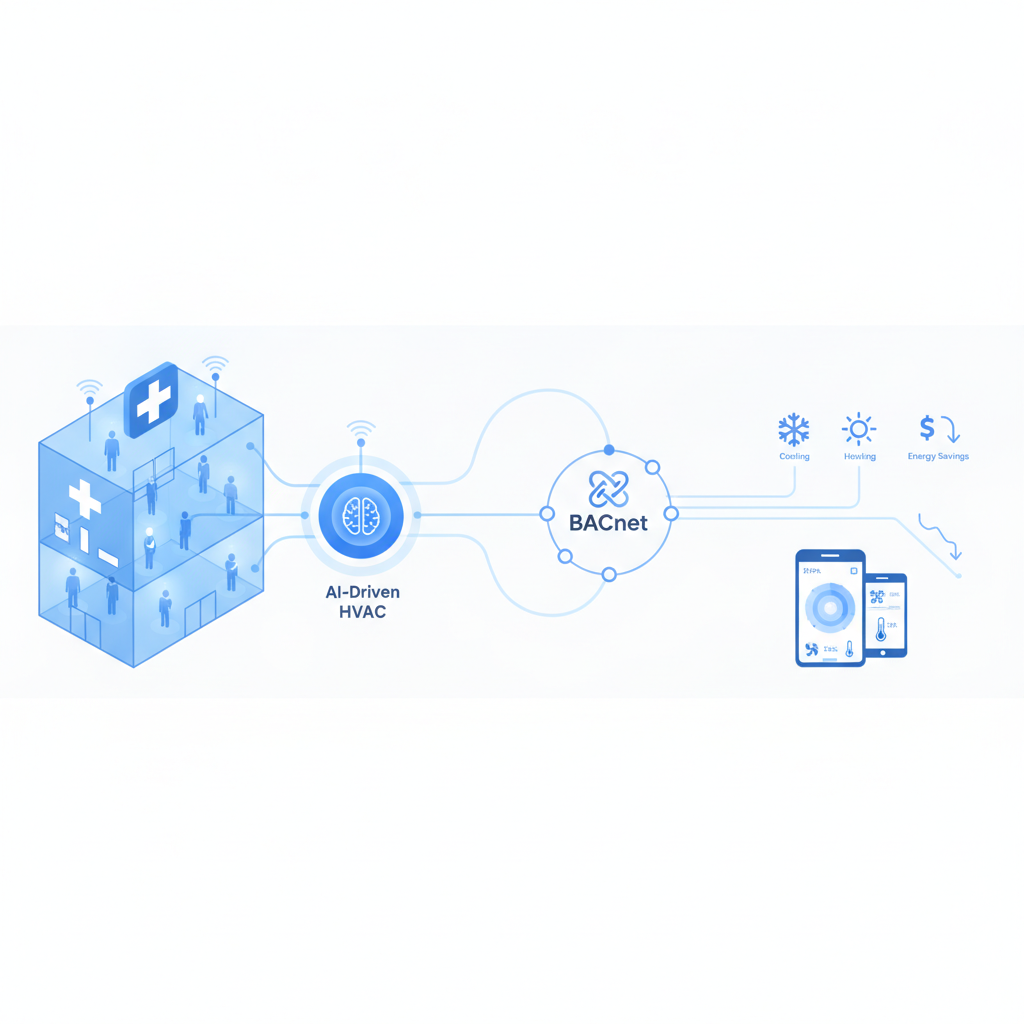
One of the most significant barriers to modernizing building infrastructure is the exorbitant cost of ripping out and replacing an existing Building Management System (BMS). R-Zero bypassed this hurdle by integrating directly into the hospital’s existing automation infrastructure using the BACnet protocol.
As the undisputed industry standard for building automation, BACnet enables secure, seamless interoperability between disparate systems. By overlaying physical AI directly onto a BACnet network, facility engineers can transform traditional, rule-based controllers into intelligent, predictive operational assets.
This methodology drastically minimizes upfront capital expenditure and operational downtime. It proves that with the proper integration strategy, legacy HVAC infrastructure can fully participate in the modern Industrial IoT ecosystem without compromise.
The Shift to Occupancy-Driven HVAC Control
For decades, commercial HVAC systems have relied heavily on static schedules. A system might run at full capacity from 6 AM to 6 PM, regardless of whether a specific zone is fully occupied or completely empty. This outdated approach results in massive energy waste and unnecessary mechanical wear and tear.
Occupancy-driven control flips this paradigm entirely. By analyzing real-time telemetry from building sensors, AI platforms can precisely modulate airflow, temperature, and ventilation based on actual human presence. In healthcare environments, this dynamic scaling is crucial for maintaining perfect patient comfort and required air exchange rates.
Achieving up to a 40% reduction in energy usage without sacrificing indoor environmental quality is a testament to the power of dynamic, data-driven building automation.
Amplifying Smart Buildings with Cloud-Based Ecosystems
While targeted AI platforms excel at optimizing specific subsystems like HVAC, realizing the full potential of a smart building requires a holistic approach. This is where comprehensive management ecosystems like BAaaS.io become invaluable to commercial real estate and healthcare operators.
The BAaaS.io platform provides a centralized cloud environment that unifies HVAC, lighting, access control, and environmental telemetry into a single integrated building information sphere. By aggregating infrastructure data across the entire property, operators gain unparalleled visibility and centralized control over their facilities.
Furthermore, combining edge-level AI logic with the proactive maintenance tools found in BAaaS.io ensures that facility managers can detect equipment anomalies early. This proactive strategy prevents critical system failures, streamlines the service lifecycle, and maximizes both energy efficiency and operational uptime.
Conclusion
The successful deployment of AI-driven HVAC control at Lucile Packard Children’s Hospital Stanford serves as a masterclass in modernizing existing infrastructure. By leveraging standard BACnet integrations and real-time occupancy data, the facility is drastically reducing its carbon footprint and operational costs without tearing out existing hardware.
As building automation continues to evolve, the integration of advanced edge AI and unified cloud platforms like BAaaS.io will become the industry standard. The future of smart buildings is no longer defined by how much new equipment is installed, but by how intelligently we utilize the data already flowing through our building networks.